Understanding Incoterms: A Simple Guide for Importers and Exporters
-

- 10 April 2026
The world of international trade is a complex web of logistics, legalities, and financial commitments. For a business looking to expand beyond domestic borders, the terminology alone can feel like a foreign language. One of the most critical components of this global dialogue is the set of rules known as Incoterms. Short for "International Commercial Terms," these three-letter acronyms define the responsibilities of buyers and sellers in the shipping process.
Without a clear understanding of these terms, a simple shipment can quickly turn into a costly nightmare involving unexpected fees or disputed insurance claims. This guide aims to demystify these rules, providing a clear roadmap for both importers and exporters to navigate the global marketplace with confidence.
Incoterms are a series of pre-defined commercial terms published by the International Chamber of Commerce (ICC). They are widely used in international commercial transactions to clarify the tasks, costs, and risks associated with the transportation and delivery of goods. Essentially, they act as a universal language for trade, ensuring that a seller in Tokyo and a buyer in London are on the exact same page regarding who pays for the freight and who is liable if the cargo is damaged.
The primary purpose of these terms is to eliminate ambiguity. According to the technical definitions provided by Wikipedia, Incoterms describe mainly the tasks, costs, and risks involved in the delivery of goods from the seller to the buyer. By incorporating a specific Incoterm into a sales contract, both parties can avoid the friction that often arises from mismatched expectations. These rules are updated periodically, usually every decade, to reflect changes in the way goods are moved globally. The current set, Incoterms 2020, includes 11 distinct rules that cover everything from local pick-ups to door-to-door deliveries.
For many businesses, the logistics side of trade is outsourced to experts. TerraLinkLogistics offers international freight and forwarding services, helping companies manage these complex terms while ensuring goods move efficiently across borders. Understanding the basics, however, remains a prerequisite for any savvy business owner.
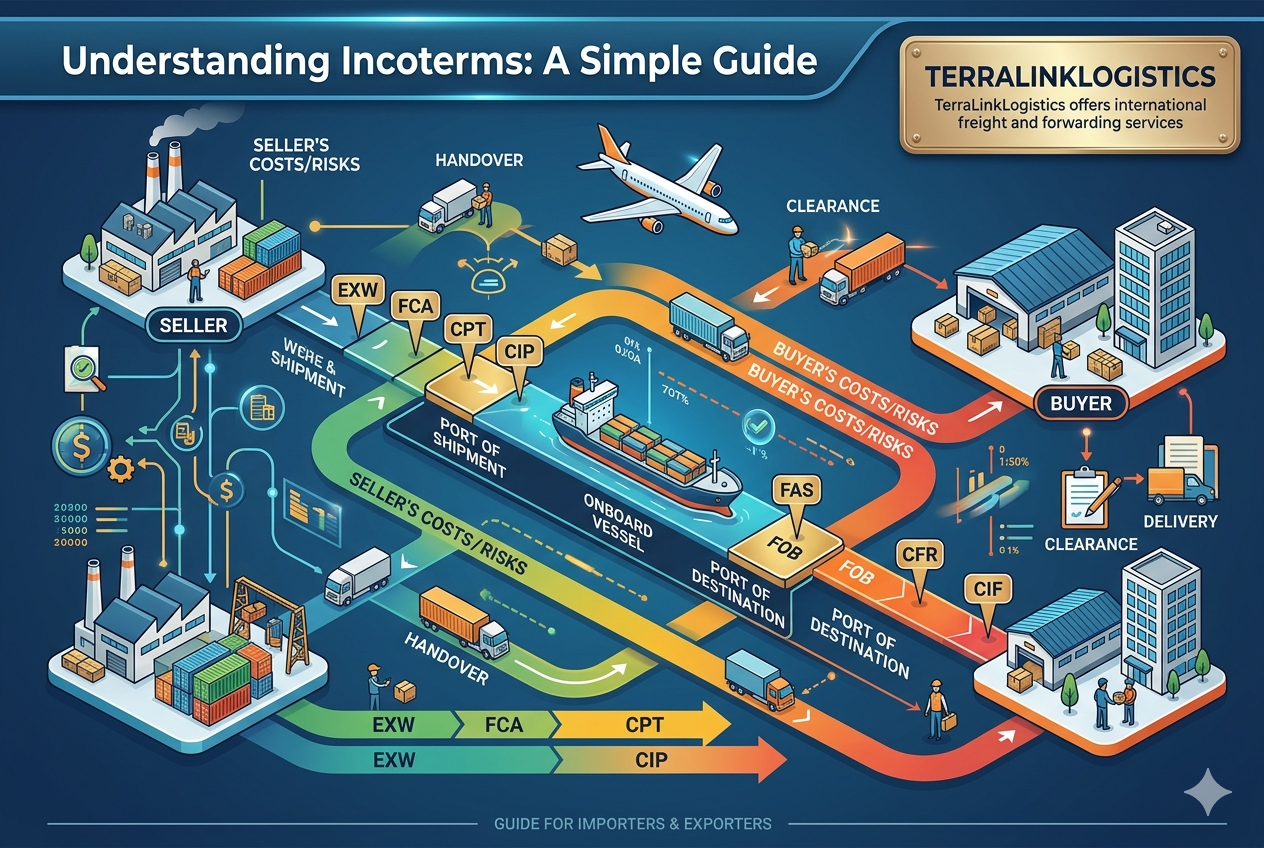
The 11 Incoterms are generally divided into two categories based on the mode of transport. The first group applies to any mode of transport, whether it be by air, rail, road, or sea. The second group is specifically reserved for sea and inland waterway transport.
These are the most versatile terms used in modern logistics. One of the most common is EXW (Ex Works). Under EXW, the seller’s only responsibility is to make the goods available at their own premises. The buyer bears all costs and risks from that point forward. While this is simple for the seller, it can be a logistical hurdle for the buyer.
On the other end of the spectrum is DDP (Delivered Duty Paid). Here, the seller assumes maximum responsibility, including the payment of import duties and taxes at the destination. While this offers the buyer a "hands-off" experience, it requires the seller to have deep knowledge of the customs regulations in the buyer's country. As noted in research shared via Google News, current trends in e-commerce are pushing more small businesses toward DDP to provide a seamless customer experience, even though it increases the seller's risk profile.
These terms are steeped in maritime tradition. FOB (Free On Board) is perhaps the most famous. It dictates that the seller delivers the goods on board the vessel nominated by the buyer at the named port of shipment. The risk of loss or damage passes to the buyer once the goods are on board the ship. It remains a staple for bulk commodities and heavy machinery shipments.
Choosing the right Incoterm is not just a matter of convenience; it is a strategic financial decision. Each term dictates a specific "point of delivery" where the risk transfers from the seller to the buyer. If a shipment is lost at sea, the Incoterm used in the contract determines which party’s insurance must cover the loss.
In a professional and analytical context, Forbes often emphasizes that supply chain resilience starts with clear contractual obligations. Businesses must analyze their internal capabilities before agreeing to a term. For instance, an exporter with a sophisticated logistics department might prefer CIF (Cost, Insurance, and Freight) because they can leverage their high shipping volumes to get better freight rates than the buyer. Conversely, a startup importer might prefer FCA (Free Carrier) to maintain control over the carrier selection and the timing of the shipment.
There are three key areas where Incoterms provide clarity:
Cost Allocation: Who pays for the packaging, the loading, the main freight, and the unloading?
Risk Transfer: At what exact geographical point does the responsibility for the goods move from the seller to the buyer?
Documentation: Who is responsible for obtaining export licenses, security clearances, and import permits?
By answering these questions upfront, businesses can price their products more accurately and avoid "hidden" costs that might erode their profit margins.
Even with a guide, errors are common. One of the most frequent mistakes is using a maritime-only term, such as FOB, for air freight or containerized shipments. In containerized shipping, the goods are often delivered to a carrier at a terminal rather than being placed directly "on board" a vessel by the seller. In such cases, FCA is the more appropriate and legally sound term to use.
Another pitfall is failing to specify the exact location. Writing "FCA Shanghai" in a contract is too vague for a city with multiple ports and hundreds of warehouses. A more professional approach is to write "FCA [Specific Warehouse Address], Shanghai, Incoterms 2020." This level of detail leaves no room for dispute regarding where the seller's responsibility ends.
Furthermore, businesses often forget that Incoterms do not cover the transfer of ownership (title) or the terms of payment. These must be addressed separately in the sales contract. An Incoterm tells you how the goods get there, but it does not tell you when the buyer officially owns them or when the money should hit the seller's bank account.
Navigating the world of international trade is a significant milestone for any growing company. While the technicalities of Incoterms may seem daunting at first, they are ultimately tools designed to protect your interests and ensure the smooth flow of commerce. By mastering these terms, you transition from a local player to a global competitor.
Effective logistics management requires a blend of theoretical knowledge and practical partnership. Whether you are looking for the simplicity of Ex Works or the comprehensive service of Delivered Duty Paid, the key is to communicate clearly with your partners and carriers. TerraLinkLogistics offers international freight and forwarding services to bridge the gap between these complex rules and your business goals, providing the expertise needed to move your cargo safely across any border.
0 Comments